
Selling a home in Sweden: a SEK 50,000 agent fee or 1.5% of the price?
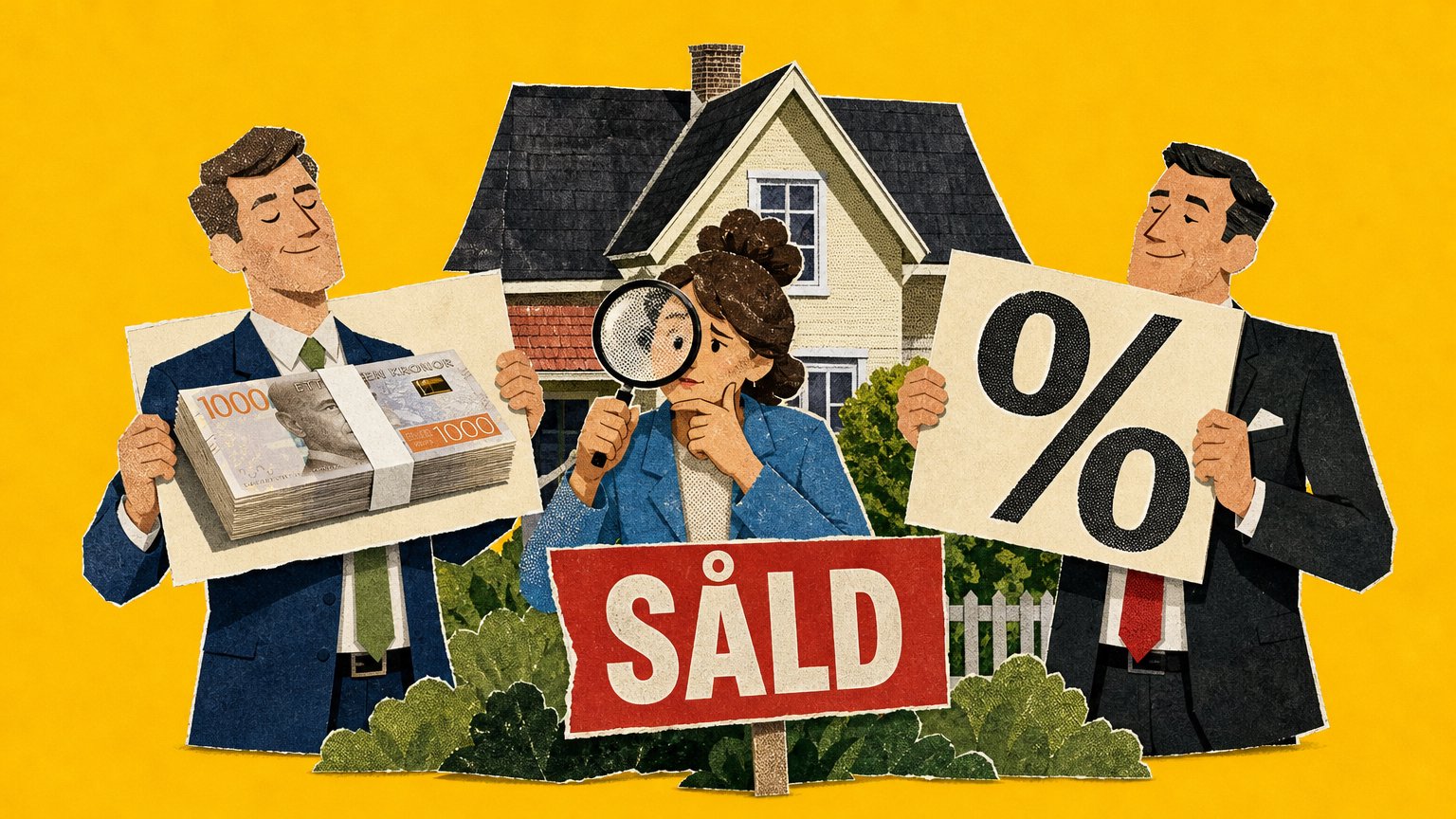
On a home that sells for SEK 4,000,000 the fixed fee is SEK 10,000 cheaper. A commission staircase can instead give the agent 10% of all above a threshold.
A fixed fee of SEK 50,000, or 1.5% of the price? On a house that sells for SEK 4,000,000, the gap is SEK 10,000.
There is no set level for what an estate agent ("fastighetsmäklare") may charge in Sweden. The fee is negotiable, and the model affects how much the agent gains from pushing up the price.
Four ways to charge
The Swedish Estate Agents Inspectorate ("Fastighetsmäklarinspektionen") lists four common models:
- a fixed percentage of the whole price
- different percentages for different price bands, known as a commission staircase ("provisionstrappa")
- a percentage with a minimum amount
- a fixed price whatever the home sells for
If the contract says nothing else, the law treats the fee as a percentage of the price.
Worked example: fixed fee against a percentage
| Final price | Fixed fee | 1.5% |
|---|---|---|
| SEK 3,800,000 | SEK 50,000 | SEK 57,000 |
| SEK 4,000,000 | SEK 50,000 | SEK 60,000 |
| SEK 4,400,000 | SEK 50,000 | SEK 66,000 |
With a fixed fee you know the cost from the start. With a percentage, the agent earns SEK 6,000 more for every SEK 400,000 on the price. You keep the remaining SEK 394,000.
A staircase can cost a lot
Mäklarsamfundet, the agents' trade body, gives an example. The fee is 1.15% up to SEK 6,000,000 and 10% on everything above. The home sells for SEK 6,610,000. The fee comes to SEK 130,000. At 1.15% on the whole price it would have been SEK 76,015.
So a staircase can hand the agent a large slice of every krona above the threshold. Mäklarsamfundet warns that a staircase can tempt the agent to understate the expected market value and set the threshold low. Ask the agent to explain why it sits where it does.
What the contract must say
The contract with the agent is called an assignment agreement ("uppdragsavtal"). It must be in writing and signed by both of you. The agent cannot rely on terms that were not agreed in writing.
Many contracts give the agent sole selling rights ("ensamrätt"). No other agent may sell the home during that period. Under the Estate Agents Act ("fastighetsmäklarlagen"), sole rights may last at most three months at a time. An extension may be agreed no earlier than one month before the period ends, and must be in writing if you are a consumer.
With sole rights, the law gives the agent the fee if the home sells during that period, even if you found the buyer yourself. Without sole rights, the agent earns the fee only if the sale came about through the agent.
The fee is not due until every condition of the sale is met. A court can reduce the fee if the agent neglected their duties.
Check that the agent is registered
Every estate agent must be registered with the Inspectorate. The Swedish Consumer Agency advises you to search the register before you hire anyone. It takes a minute on fmi.se.
The asking price is not a promise
Setting a deliberately low asking price ("utgångspris") is banned. But the Supreme Administrative Court ruled in 2025 that the asking price and the market value are not the same thing. A final price above the asking price does not on its own prove that the agent used a bait price.
Ask the agent what price they expect, and decide the lowest price you would accept.
The fee lowers your tax
The agent's fee is a cost of sale. You deduct it when you calculate your gain. The tax on the gain is 22%. A SEK 60,000 fee therefore cuts your tax by SEK 13,200 if you make a gain.
How to compare
Ask two or three agents for a valuation and a written proposal. Ask what is included, such as photos, styling and advertising. Then compare the fee at three different final prices, as in the table above.
What happens to your mortgage once the home is sold is covered in the selling chapter of our mortgage crash course.
Sources
- Riksdagen: Estate Agents Act 2021:516 (Swedish)
- Swedish Estate Agents Inspectorate: Commission (Swedish)
- Swedish Estate Agents Inspectorate: Find an agent (Swedish)
- Swedish Estate Agents Inspectorate: Asking price and market value are not the same (Swedish)
- Swedish Consumer Agency: Tips before you hire an agent (Swedish)
- Mäklarsamfundet: What to consider with a commission staircase (Swedish)
- Skatteverket: Selling a home (Swedish)
- Skatteverket: Calculating gain, loss and tax (Swedish)
This content is general information, not financial or legal advice. Bolån Radar collects data from banks and authorities and cannot guarantee that it is complete or free of errors. Talk to your bank or an adviser before you decide.