
Fixing a Swedish mortgage for 3 years? Variable must rise 0.49 points
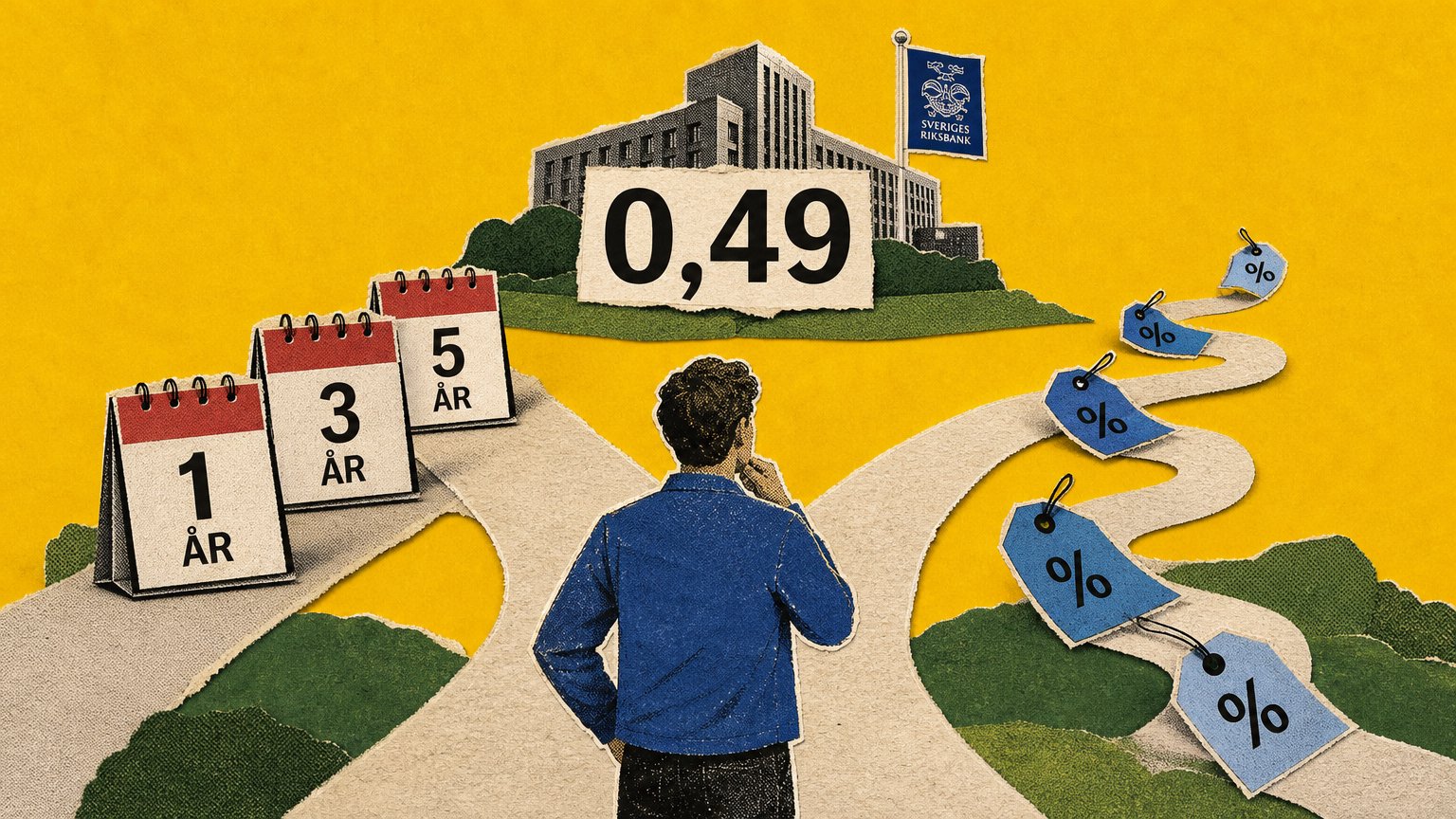
SEB's August 2026 averages: 2.67% variable, 3.16% fixed for three years. On the Riksbank forecast, fixing saves only about SEK 1,800 a year.
A mortgage fixed for three years only pays off if the variable rate rises by more than 0.49 points on average over those years. That was the gap between SEB's average three-year and three-month rates in August 2026.
The Riksbank expects to raise its policy rate. Should you fix your mortgage now, or stay on a variable rate? You can work that out.
Start from what customers actually pay
List rates tell you little. Use the banks' average rates ("snitträntor"), which show what customers paid on average for new loans. At SEB, the average rate in August 2026 was 2.67% for a three-month term and 3.16% for three years. The gap is 0.49 percentage points.
On a loan of SEK 3,000,000, the interest is:
| Term | Rate | Per year | Per month |
|---|---|---|---|
| Variable, 3 months | 2.67% | SEK 80,100 | SEK 6,675 |
| Fixed, 3 years | 3.16% | SEK 94,800 | SEK 7,900 |
That is before tax relief. The fixed rate costs SEK 14,700 more in the first year.
The break-even point: 0.49 points on average
The fixed rate only pays off if the variable rate is, on average, more than 0.49 points higher over the three years. The word average matters. A hike that comes late only counts for the time that is left.
Some examples:
- No hikes. The variable rate stays put. You save SEK 44,100 over three years with the variable rate, before tax relief.
- Two hikes of 0.25 right away. The variable rate is 0.50 points higher for the whole period. The two options come out about even.
- The Riksbank forecast. In September 2026, the Riksbank expected an average policy rate of 1.85% at the end of 2026, 2.38% in autumn 2027 and just over 2.4% in 2028. If the variable mortgage rate follows, it will be about 0.55 points higher than today on average. The fixed rate then comes out about SEK 1,800 a year cheaper.
- Faster hikes. The Riksbank says it will raise faster if inflation rises more. The fixed rate then wins more clearly.
So the forecast gives almost a draw. That tells you more about your own risk than about which option will be cheapest. The interest rates chapter of our mortgage crash course explains more about variable and fixed rates.
The real question is what risk you can carry
With a fixed rate, you know your cost for three years. With a variable rate, you carry the risk yourself, but you do not pay for a hike that may never come. In June 2026, 80% of people taking a new or renegotiated mortgage chose a variable rate, according to Finansinspektionen, the Swedish financial supervisor.
Ask yourself three questions:
- Can you handle a higher monthly cost? Work out the cost with a rate one point higher. On SEK 3,000,000, that is SEK 2,500 more a month before tax relief.
- Might you sell or switch banks soon? If you repay a fixed loan early, the bank can charge an interest differential fee ("ränteskillnadsersättning").
- Do you want to spread the risk? You can split the loan, for example half variable and half fixed.
How the interest deduction changes the numbers
The interest deduction ("ränteavdrag") is 30% of your interest cost up to SEK 100,000 per person a year. Above that, it is 21%. In the example the interest stays under SEK 100,000 a year, even for a single borrower. Every amount above then shrinks by 30% after tax.
Sources
- Bolån Radar: SEB average rates, three months and three years
- Riksbank: policy rate unchanged at 1.75 per cent, 24 September 2026
- Finansinspektionen: mortgage rates have levelled out, 4 September 2026
- Skatteverket: tax reductions, deficit of capital
This content is general information, not financial or legal advice. Bolån Radar collects data from banks and authorities and cannot guarantee that it is complete or free of errors. Talk to your bank or an adviser before you decide.