
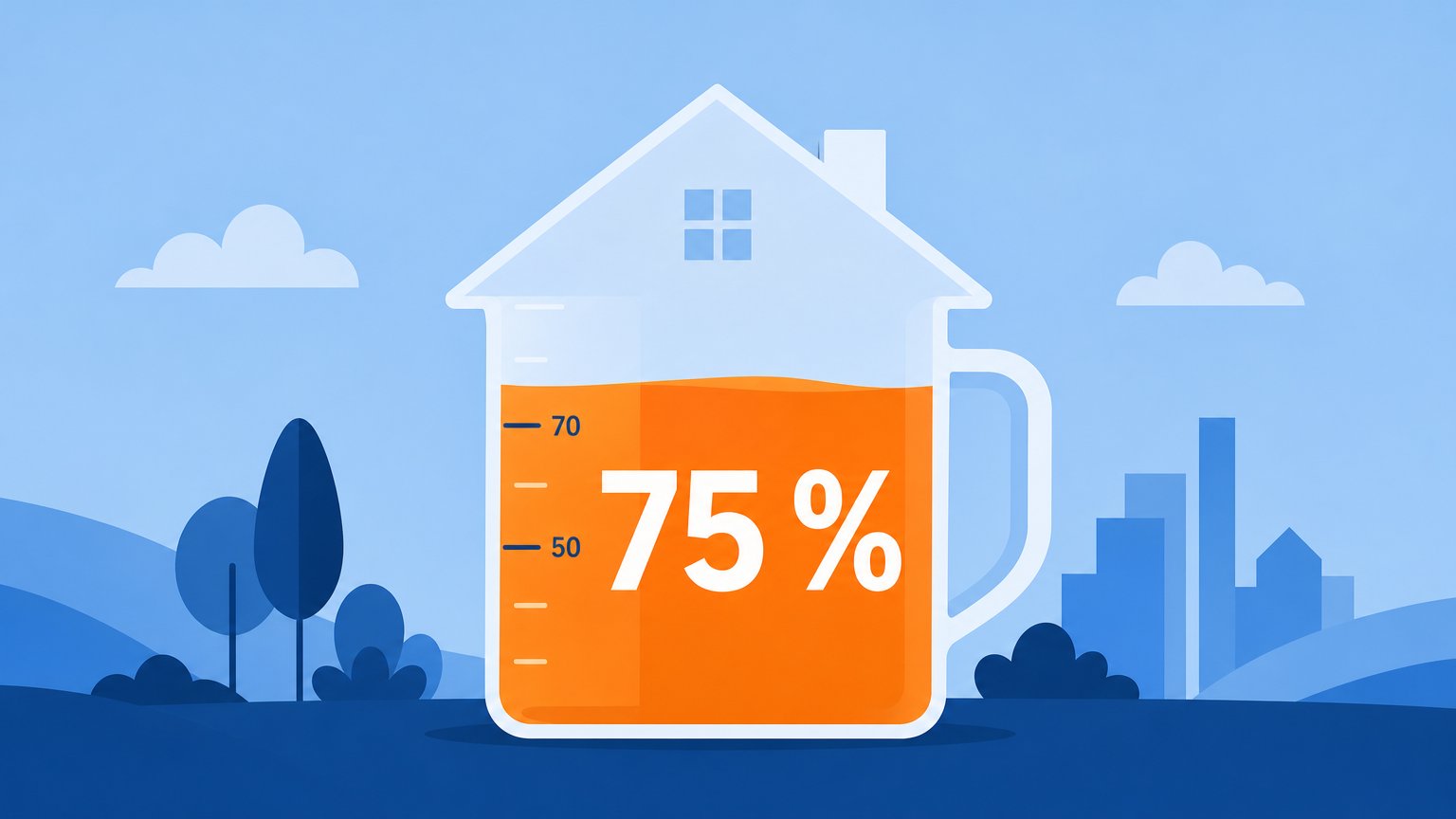
75% loan-to-value in Sweden: SEK 60,000 a year to amortize on SEK 3m
Below 70%, 1% amortization is enough, and SBAB's example rates apply at 60% or less. Your lender must show how it worked out your loan-to-value.
Borrow SEK 3,000,000 on a home worth SEK 4,000,000 in Sweden and your loan-to-value ratio ("belåningsgrad") is 75%, which means amortizing SEK 60,000 a year.
The ratio is the loan divided by the home's value. That one number decides how much you must amortize, and at many lenders it also sets your rate.
Amortization comes in three steps
Since 1 April 2026, the amortization requirement ("amorteringskrav") sits in the Act on Limiting Mortgage Credit ("lagen om begränsning av bostadskrediter"). It used to be in the regulations of Finansinspektionen, the financial supervisor. The levels have not changed:
| Loan-to-value | Amortization per year |
|---|---|
| 50% or less | No requirement |
| Above 50% up to 70% | At least 1% |
| Above 70% | At least 2% |
What went on 1 April 2026 was the stricter amortization rule ("skärpt amorteringskrav"). Borrowers with loans above 4.5 times their gross income had to pay an extra 1%. If you have such a loan, the extra requirement does not end by itself. You have to agree new terms with your bank.
Worked example: 75% loan-to-value
With a SEK 3,000,000 loan on a SEK 4,000,000 home you are above 70%. You must amortize 2% a year.
- 2% of SEK 3,000,000 is SEK 60,000 a year.
- That is SEK 5,000 a month on top of interest.
The percentage applies to the highest loan amount since the latest valuation. So you keep paying SEK 60,000 a year even as the debt shrinks.
Once the loan is down to SEK 2,800,000, your loan-to-value ratio is 70%. Then 1% is enough, or SEK 30,000 a year. At SEK 60,000 a year it takes just under three and a half years to get there.
Loan-to-value also drives your rate
Several lenders price directly from your loan-to-value ratio. SBAB says it sets the rate from how much you borrow compared with the home's value. Its example rates apply at 60% or less. Stabelo uses only loan size, loan-to-value and fixed term. Anyone with the same figures gets the same rate there.
The big banks negotiate more, but Swedbank too lists loan-to-value as one of the factors behind your rate. A lower ratio is a strong point when you negotiate. You can see what each bank charges at your loan-to-value ratio on our personalized rates page.
How to lower your loan-to-value
There are two ways: a smaller loan or a higher value.
Pay down the loan. Every krona you repay lowers the ratio. An extra payment just before you cross 70% or 50% can cut both the requirement and the rate.
Get a new valuation. The lender starts from the price you paid. Under the act, the home may be revalued at the earliest five years after the purchase, or after the last revaluation that changed your amortization or borrowing room.
If the value has changed a lot for reasons other than general price trends, it can happen sooner. The government bill gives major renovation, conversion and extensions as examples. Redoing a single room or adding a deck usually does not count.
What counts is the rise in value, not what the work cost.
You have a right to the figures
On request, the lender must show how it calculated your loan-to-value and your amortization requirement. You must be able to get this electronically. Ask for it if the number looks wrong.
The loan-to-value cap is a separate limit
There is also a ceiling. When you buy a home, you may borrow at most 90% of its value under the loan-to-value cap ("bolånetak"). When you top up an existing loan, the ratio afterwards may be at most 80%.
Sources
- Riksdagen: Act 2026:226 on limiting mortgage credit (Swedish)
- Finansinspektionen: FI repeals its mortgage regulations (Swedish)
- Government: New rules on home ownership, press release (Swedish)
- Government: Bill 2025/26:119 (Swedish)
- SBAB: Our rates (Swedish)
- Stabelo: Rates (Swedish)
- Swedbank: Mortgage rates (Swedish)
This content is general information, not financial or legal advice. Bolån Radar collects data from banks and authorities and cannot guarantee that it is complete or free of errors. Talk to your bank or an adviser before you decide.