
Sweden's policy rate is flat at 1.75%: why fixed mortgages cost more
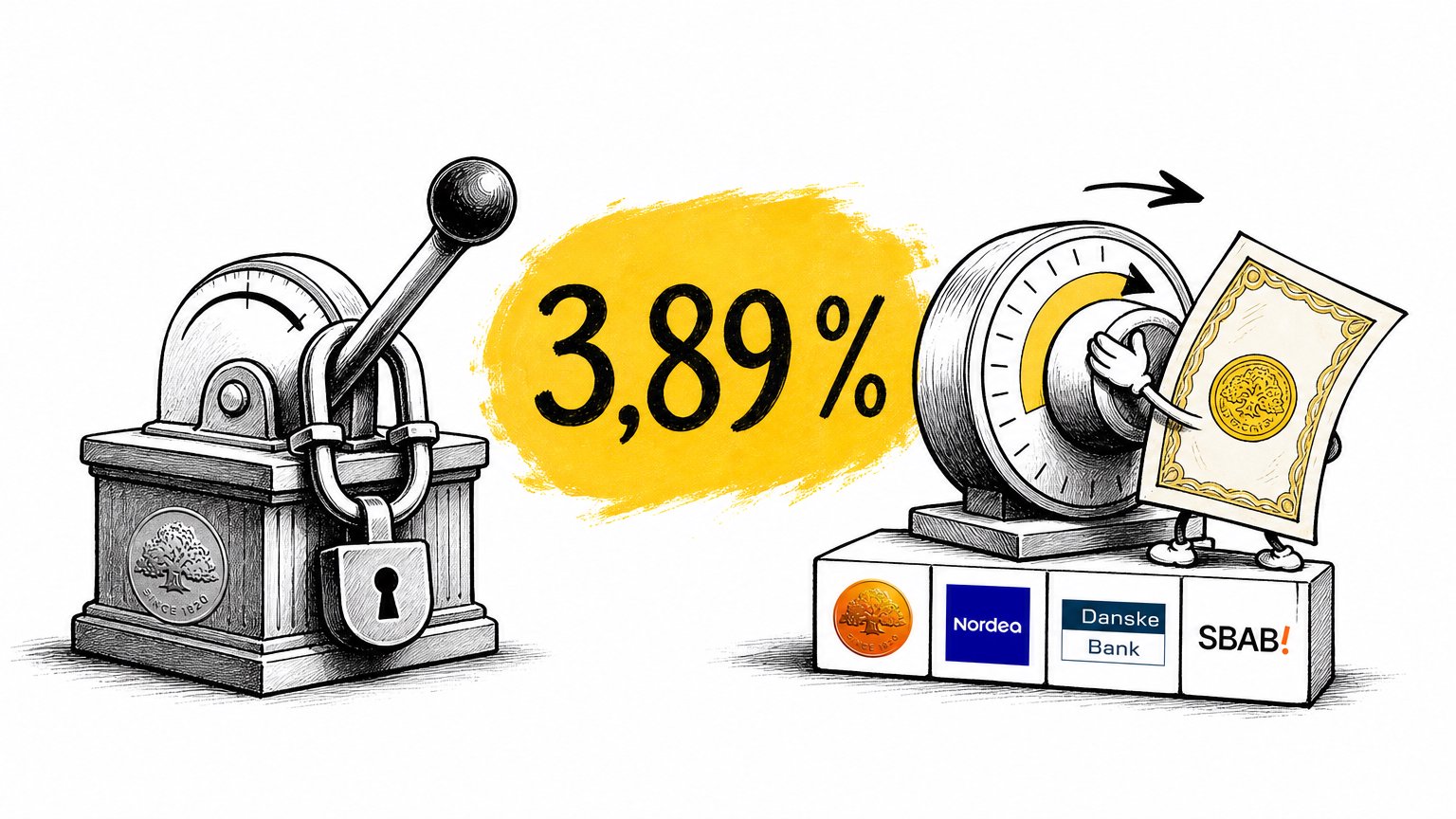
Banks fund fixed mortgages with bonds. The yield on two-year mortgage bonds rose from 2.42% on 1 July 2026 to 3.13% on 18 September 2026.
On 18 September 2026, Swedbank raised its two-year list rate by 0.25 percentage points to 3.89%. In the week before, Nordea, Danske Bank, SBAB, Skandia and Länsförsäkringar had raised their fixed rates. Six days later, the Riksbank left the policy rate ("styrränta") unchanged at 1.75%. How do the two fit together?
Fixed rates follow the market, not the policy rate
Banks raise much of the money for mortgages by issuing bonds. When you fix your rate for two years, the bank wants to borrow for two years too. So fixed mortgage rates follow market yields on bonds, not today's policy rate.
Those yields have risen over the summer and autumn. Riksbank statistics show the yield on two-year Swedish mortgage bonds at 2.42% on 1 July 2026. It was 2.84% on 8 September 2026 and 3.13% on 18 September. When the bank's own cost rises by several tenths of a point, it raises its list rate.
The market expects hikes
Bond yields rose because markets expect higher policy rates. On 10 September 2026, the European Central Bank raised its rates by 0.25 points. On 24 September, the Riksbank said its rate should rise more than it expected in June 2026. If the outlook holds, the hikes are expected to start this year.
The Riksbank forecast puts the policy rate at an average of 2.07% in the first quarter of 2027 and 2.38% in the third quarter. It points to the war in the Middle East, dearer oil, electricity and fuel, and a weaker krona. A two-year or five-year rate prices in exactly these expectations today.
Variable rates follow the policy rate
The variable rate, fixed for three months, tracks the policy rate much more closely. That is why banks left it unchanged in September 2026. It can start to rise once the Riksbank actually hikes, or when markets are sure a hike is coming.
What the rise costs you
Say you fix SEK 3,000,000 for two years. A rise of 0.25 points costs SEK 7,500 more a year. After the 30% interest deduction ("ränteavdrag") it is SEK 5,250.
Remember that few borrowers pay the list rate. Swedbank's average two-year rate on new loans was 3.16% in August 2026. Its list rate before the rise was 3.64%. The average rate ("snittränta") shows what customers actually paid.
Should you fix now?
Nobody knows for sure where rates go. These points can help you choose:
- Compare average rates, not list rates. The gap between banks can be several tenths of a point.
- Negotiate. Show your bank a better offer or a lower average rate at a competitor.
- Work out both options. A fixed rate gives you a known cost. A variable rate is lower today, but the Riksbank expects it to rise.
Does your fixed term end this autumn? Start comparing the banks' current rates a few weeks before, so you have time to move the loan if another offer is better.
Sources
- Placera/Direkt: Swedbank raises fixed mortgage rates, 18 September 2026
- Riksbank: policy rate unchanged at 1.75 per cent, 24 September 2026
- Riksbank: interest rates and exchange rates
- ECB: monetary policy decisions, 10 September 2026
- Bolån Radar: Swedbank two-year average rates
- Skatteverket: tax reductions, deficit of capital
This content is general information, not financial or legal advice. Bolån Radar collects data from banks and authorities and cannot guarantee that it is complete or free of errors. Talk to your bank or an adviser before you decide.