
Split a Swedish mortgage in 3: a hike costs SEK 10,000, not SEK 30,000
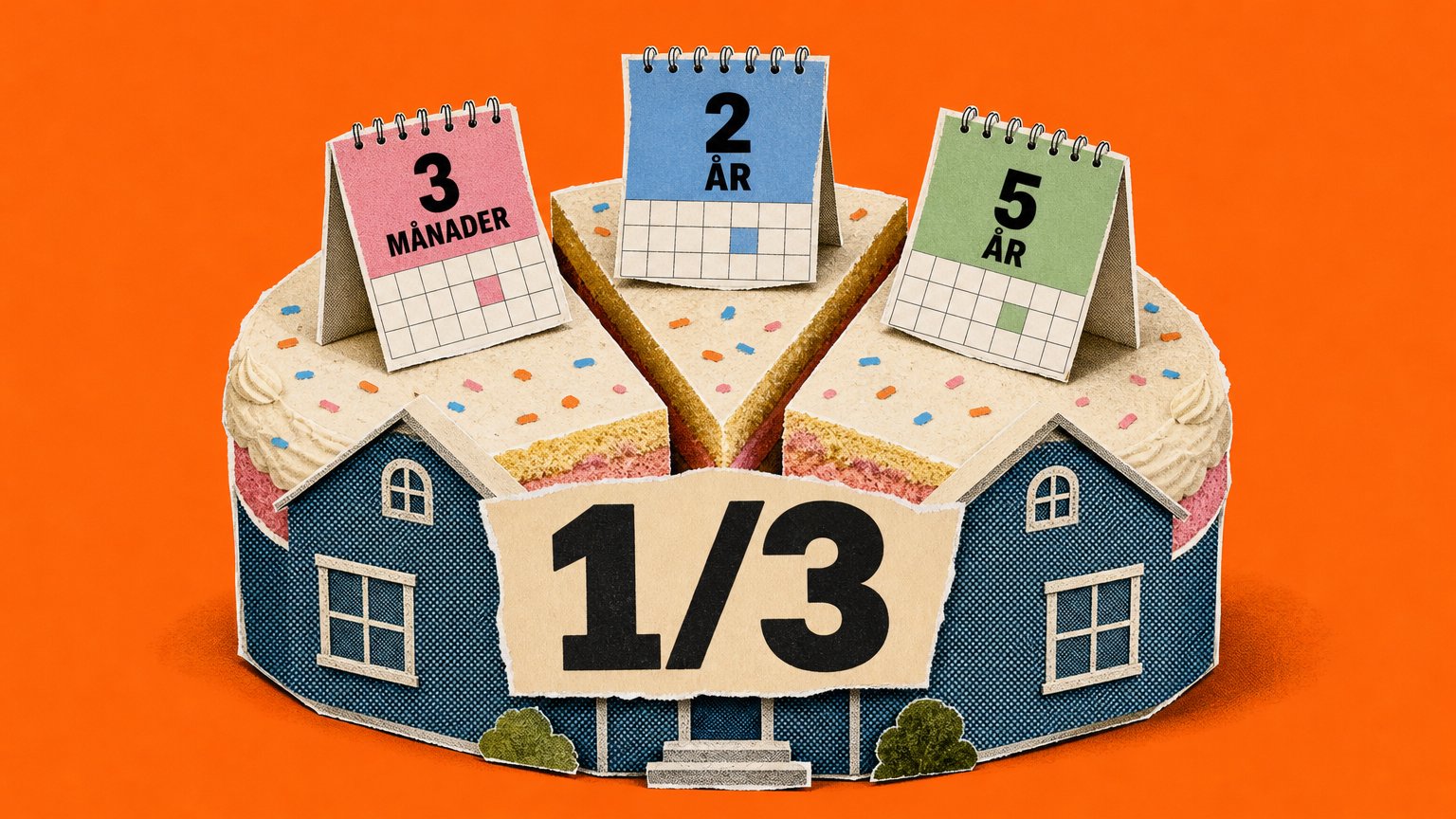
At SEB's September 2026 average rates, a split SEK 3,000,000 loan costs SEK 94,200 a year. That is SEK 14,400 more than going all variable.
Split a SEK 3,000,000 mortgage across three fixed terms, and a 1-point rise in the variable rate costs SEK 10,000 a year. With an all-variable loan it costs SEK 30,000.
You do not have to choose between variable and fixed. You can split your mortgage into parts with different fixed terms ("bindningstider"). A rate rise then only hits part of the loan, and the parts come up for renewal at different times.
The example: SEK 3,000,000 in three parts
Take SEB's average rates for September 2026: 2.66% for three months, 3.29% for two years and 3.47% for five years. Split the loan into three equal parts of SEK 1,000,000.
| Set-up | Interest per year | Per month |
|---|---|---|
| All variable | SEK 79,800 | SEK 6,650 |
| All two-year | SEK 98,700 | SEK 8,225 |
| All five-year | SEK 104,100 | SEK 8,675 |
| One third of each | SEK 94,200 | SEK 7,850 |
The amounts are before tax relief. Today the all-variable loan is cheapest. The split costs SEK 14,400 more a year than going all variable. That is the price of knowing the cost of two thirds of the loan.
When rates move
Say the variable rate rises 1 percentage point:
- All variable: SEK 30,000 more a year.
- Split loan: SEK 10,000 more a year. Only the variable part is affected.
- All five-year: no change until the fixed term ends.
If rates fall 1 point, the same works the other way. The split loan saves SEK 10,000, the all-variable loan SEK 30,000. The split gives you a smaller gain and a smaller loss.
In September 2026, the Riksbank expected its policy rate to rise to about 2.4% during 2027. Nobody knows if that will happen. A split loan means you do not have to guess right. The loan structure chapter of our mortgage crash course shows more ways to set up the loan.
Two other ways to split
You do not have to use three parts. Two examples with SEB's average rates for September 2026:
- Half variable, half three-year. The three-year rate was 3.32%. Interest comes to SEK 89,700 a year. If the variable rate rises 1 point, it costs SEK 15,000 more.
- 70% on five years, 30% variable. Interest comes to SEK 96,810 a year. If the variable rate rises 1 point, it costs SEK 9,000 more.
The more you fix, the less a rise affects you. But you also pay more today.
The parts renew at different times
The second benefit shows after a couple of years. The two-year part renews in autumn 2028 and the five-year part in 2031. So you never reset the rate on the whole loan at once. If rates have risen when one part renews, it only affects that part.
It also gives you more chances to negotiate. Each time a part renews, you can compare offers from other banks.
Keep in mind
- Fixed parts cost money to repay early. If you sell your home or switch banks before the term ends, the bank can charge an interest differential fee ("ränteskillnadsersättning").
- Extra amortization fits best on the variable part. There you can pay down without that fee.
- You do not have to split equally. If your margin is thin, fix more. If you have a large buffer, keep more variable.
- Ask your bank about minimum amounts. Each loan part may have a lowest size.
How to get started
- Work out how much higher a monthly cost you can carry.
- Decide how much of the loan needs a known cost.
- Pick fixed terms that end in different years.
- Compare average rates for each term, not just the list rate.
Sources
- Bolån Radar: SEB average rates, September 2026
- Riksbank: policy rate unchanged at 1.75 per cent, 24 September 2026
This content is general information, not financial or legal advice. Bolån Radar collects data from banks and authorities and cannot guarantee that it is complete or free of errors. Talk to your bank or an adviser before you decide.