
First home in Sweden: 10% down means SEK 125,000 less to save
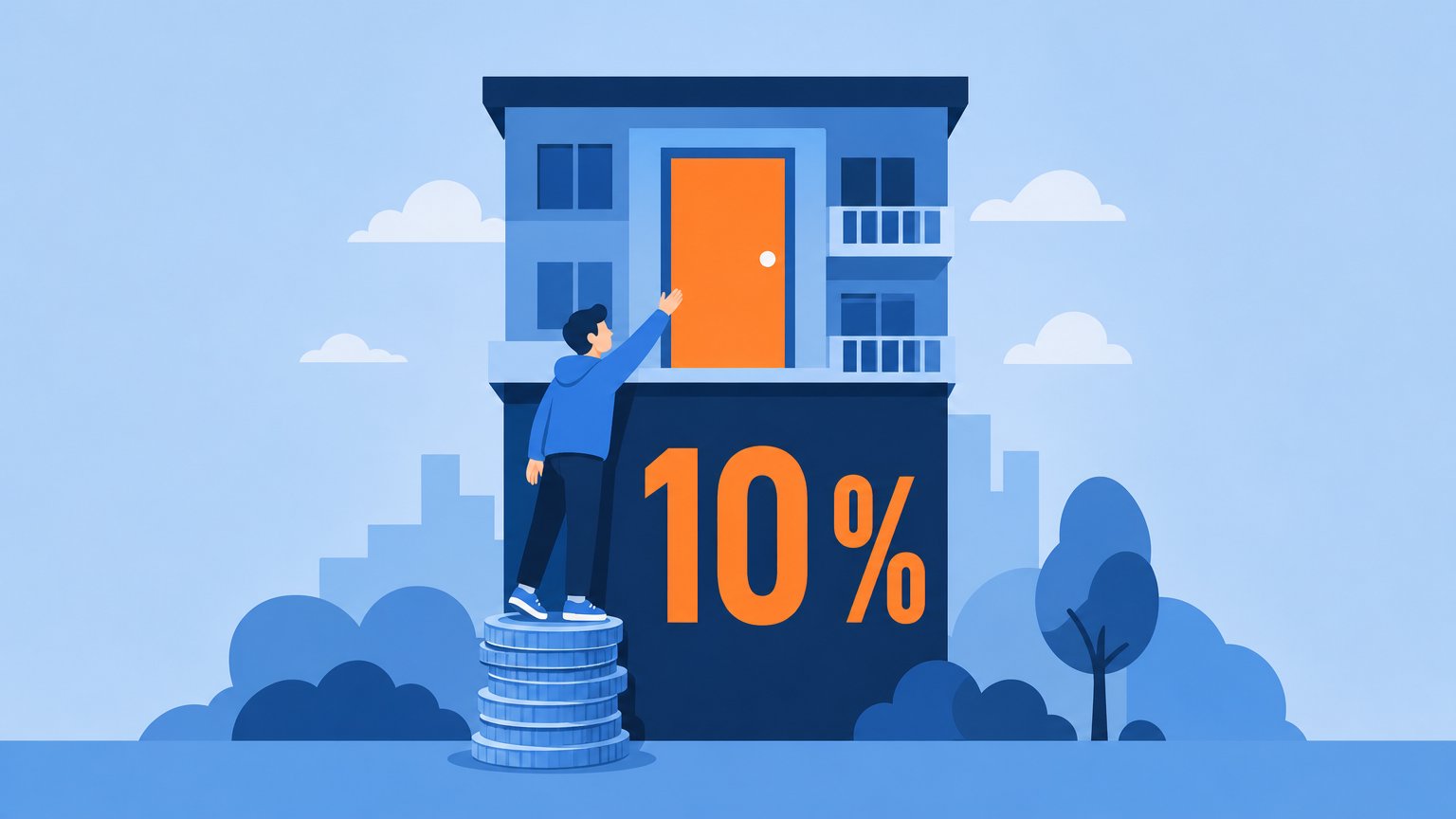
A SEK 2.5 million flat needs SEK 250,000 down, but costs just under SEK 500 more a month. The bank's stress rate decides how much you can borrow.
From 1 April 2026, a 10% down payment ("kontantinsats") is enough in Sweden. For a SEK 2,500,000 co-op flat you need SEK 250,000 instead of SEK 375,000. That is SEK 125,000 less to save.
But the loan-to-value cap ("bolånetak") only sets the most a bank may lend. Whether you can borrow that much depends on the bank's own calculation.
What the new rule says
In March 2026 the Riksdag voted to raise the loan-to-value cap from 85% to 90% when you buy a home. The rule applies to loans taken from 1 April 2026.
At the same time, the stricter amortization rule went. It required an extra 1% amortization a year if the loan was more than 4.5 times the household's gross income.
For a first-time buyer this means two things:
- You need less money saved.
- A high debt compared with your salary no longer adds extra amortization.
The example: a two-room flat for SEK 2,500,000
| 85% cap | 90% cap | |
|---|---|---|
| Down payment | SEK 375,000 | SEK 250,000 |
| Mortgage | SEK 2,125,000 | SEK 2,250,000 |
| Interest per month at 2.68% | SEK 4,746 | SEK 5,025 |
| Amortization per month, 2% | SEK 3,542 | SEK 3,750 |
| Total per month | SEK 8,288 | SEK 8,775 |
The rate in the example is 2.68%. That was the banks' median variable mortgage rate in March 2026, according to Bolån Radar's monthly report. The personalized rates page shows what rate you could get at a 90% loan-to-value ratio, with each bank's loan-to-value discounts applied.
The 30% interest deduction ("ränteavdrag") cuts the interest cost to about SEK 3,518 a month on the larger loan. The monthly fee to the housing association comes on top, as do electricity and home insurance.
So the larger loan costs just under SEK 500 more a month. In return you need to save SEK 125,000 less.
Both loans are above 70% of the home's value. That means the rule to pay off 2% of the loan a year applies in both cases.
The bank's calculation decides
Before you get a mortgage pre-approval ("lånelöfte"), the bank runs a "left to live on" calculation ("kvar att leva på-kalkyl"). It takes your income after tax and subtracts:
- the mortgage interest, at a stress rate ("kalkylränta") far above today's rate
- the amortization
- the fee to the housing association, or the running costs of a house
- your other loans, such as student loans and car loans
- a standard amount for living costs per adult and child
If money is left each month, you can borrow. Each bank chooses its own stress rate and its own standard amounts. According to the Riksbank, several banks used a stress rate of just over 6% in 2024. Ask your bank which figures it uses today.
This is how much the stress rate matters. With a SEK 2,250,000 loan and a stress rate of 7% as an example, the bank counts SEK 13,125 a month in interest. That is more than twice the interest you actually pay today.
A lower down payment does not change how far your salary goes. If your income only supports a SEK 2,000,000 loan, having SEK 250,000 saved will not help. Your salary sets the limit.
The down payment must be your own money
If you borrow the down payment with an unsecured loan, the bank includes that loan in its calculation. That lowers how much you can borrow for the home. The rate on a personal loan is also normally higher than a mortgage rate.
Remember the costs around the purchase
The down payment is not the only money you need. When you buy a co-op flat, the association may charge a transfer fee and a pledge fee. Moving, furniture and a buffer for surprises cost money too. A buffer matters more when you borrow 90%. If prices fall 10%, your loan equals the value of your home.
Next steps
- Work out what you can pay each month at a higher rate than today's.
- Apply for a pre-approval at one or more banks. Ask how much you can borrow and at what rate.
- Read the association's annual report before you bid. A high fee or an association with large loans lowers how much you can borrow.
- Plan to pay off 2% a year until the loan is below 70% of the home's value.
Sources
- New law changes to help more people own their home, Government of Sweden (in Swedish)
- Riksbank: Credit assessment for mortgages, staff memo June 2024 (in Swedish)
- Government bill 2025/26:119 on macroprudential policy, Riksdag (in Swedish)
- Bolån Radar's monthly report on average rates for March 2026
This content is general information, not financial or legal advice. Bolån Radar collects data from banks and authorities and cannot guarantee that it is complete or free of errors. Talk to your bank or an adviser before you decide.